


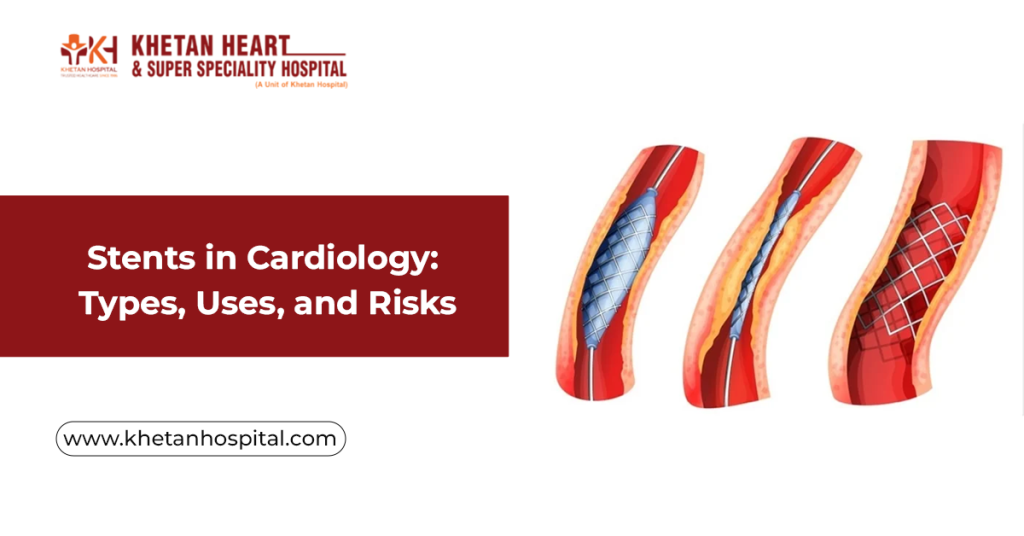
Over time, plaque can build up in a heart artery, making it narrow and harder for blood to reach the heart. Some people manage the problem with medicines, and others may need a procedure to improve blood flow. One such option is a stent. This guide explores Stents in cardiology, when they are used, the different types, how they are placed, and the risks to know about.
What Is a Heart Stent?
It is a small mesh tube placed inside a narrowed or blocked artery. Once opened, it supports the artery and helps blood move through it more easily. A coronary stent is usually placed during angioplasty. It stays inside the artery after the procedure and becomes part of the vessel as it heals.
How Does a Heart Stent Work?
When plaque builds up inside an artery, the space for blood to pass through becomes smaller. During angioplasty, the doctor uses a small balloon to open the narrowed area.
The stent is then expanded at that spot. After the balloon and catheter are removed, the stent remains there to support the artery and keep the passage open.
Types of Heart Stents
There are different Types of heart stents, but two are commonly discussed for coronary arteries.
- Bare-Metal Stents: These are simple metal mesh tubes without a medicine coating. They can keep the artery open, although tissue can grow inside the stent and cause the artery to narrow again.
- Drug-Eluting Stents: These have a medicine coating that is released slowly after placement. The medicine helps reduce tissue growth and lowers the chance of the artery becoming narrow again.
When Are Stents Used?
Stents in cardiology may be considered when a coronary artery is significantly narrowed or blocked and restoring blood flow is likely to help.
A stent may be recommended when:
- Chest pain continues despite treatment
- A significant blockage is found
- An artery needs to be opened during certain heart attacks
- Angioplasty is suitable for the patient
A blockage does not automatically mean a stent is needed. Some patients may be treated with medicines, while others may benefit from bypass surgery.
Common Stent Procedure
A Coronary stent procedure is one of the common ways a stent is placed in a heart artery. The cardiologist guides a thin catheter through a blood vessel, usually from the wrist or groin, and moves it towards the narrowed area.
A small balloon may be used to widen the artery. The stent is then placed at the same spot to help keep the artery open. The catheter is removed after the procedure.
Where Else Are Stents Used?
Stents aren’t just for heart arteries. If a narrowed or blocked area is affecting blood flow, doctors may use them in other blood vessels. It can be used in:
- Carotid arteries: To increase blood flow to the brain in certain patients.
- Peripheral arteries: To increase blood flow in the legs, arms or pelvis.
- Aorta: A stent-graft may be used for some aortic aneurysms.
- Renal arteries: To improve blood flow to the kidneys in selected cases.
The type of stent and need for the procedure depend on the condition being treated.
What Are the Risks?
Like any medical procedure, stenting has some possible risks. Most patients do well, but complications can happen.
Possible risks include:
- Bleeding or bruising where the catheter was inserted
- Blood-vessel damage
- Reaction to the contrast dye
- A blood clot inside the stent
- Re-narrowing of the artery
- Heart attack or stroke in uncommon cases
If you are looking for the Best Cardiology Hospital In Jaipur, choose a Khetan Hospital where the cardiologist explains the possible risks based on your own condition.
What Happens After a Stent?
Stent placement is not the end of the treatment. You may need to take antiplatelet medication to lower your chances of a clot forming within the stent. Your cardiologist will decide what medicine you need and how long to take it. Don’t stop it on your own.
Your doctor might also ask you to:
- Keep on moving as much as your doctor says you can
- Eat a well-rounded diet
- Keep cholesterol and blood pressure under control
- If you smoke, stop smoking
Final Thoughts
A stent in Cardiology can help restore blood flow through a narrowed coronary artery when it is the right treatment for the patient. But the decision should not be based on the blockage alone.
If your doctor has suggested a stent, ask why you need it, whether there are other options, and what medicines you will need afterwards. Understanding the reason for the procedure can make your treatment decision much clearer.