


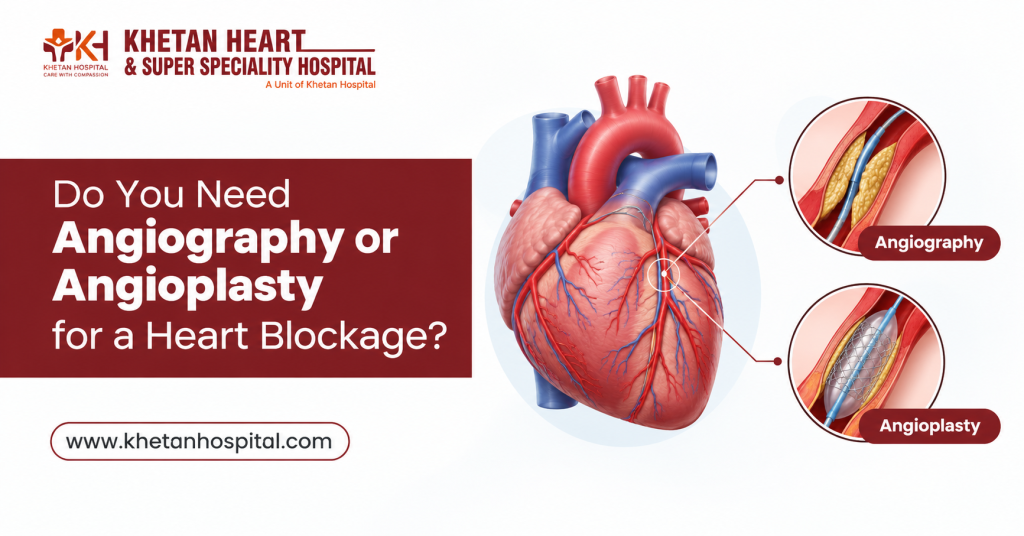
Finding out that you have a Angiography or Angioplasty can leave you with many questions. One of the most common is whether you need an angiography or an angioplasty. Although the names sound almost the same, these procedures have different purposes. Angiography is used to look at the coronary arteries, while angioplasty is performed to open certain narrowed arteries.
What’s the difference between angiography and angioplasty?
The basic difference between Angiography or Angioplasty is simple. Angiography allows the cardiologist to see the coronary arteries and determine where they are narrowed or blocked. Angioplasty is a procedure to open up some narrowed arteries.
Whereas in angiography, a thin tube is passed through a blood vessel and contrast dye is injected to view the coronary arteries on X-ray images. “If the images show that there is a blockage that needs treatment, angioplasty may be an option.
When Do Doctors Recommend Angiography?
If your doctor wants to have a closer look at your coronary arteries, Angiography for Heart Blockage may be advised. It can help if you have chest pain, shortness of breath or a problem found in another heart test. Usually, a thin tube is put through the wrist or groin for the procedure, and dye is used to show the arteries on an X-ray.
The test can show:
- Where the artery is narrowed
- How serious the narrowing appears
- Whether one or several arteries are affected
- Whether further treatment may be needed
When Is Angioplasty Needed?
Angioplasty for Heart Blockage may be recommended when a narrowed coronary artery is affecting blood flow and opening it is expected to help.
It is not decided simply by looking at the percentage of blockage. The cardiologist also considers the person’s symptoms, the artery involved, blood flow, heart function, and other health problems.
In some patients, medicines may be enough. In others, bypass surgery may be discussed instead of angioplasty
What Happens During Angioplasty?
During angioplasty, the cardiologist directs a catheter to the narrowed part of the coronary artery. They inflate a tiny balloon in the narrowed section to open the passage.
Afterward, a stent is often inserted. It is like a small support inside the artery, helping to keep the treated area open. Usually, the patient is awake during the procedure, but may be given medicine to help him or her relax. The medical team then observes the patient for a time to judge when they are fit to go home.
Does Every Blockage Need a Stent?
No. Just because there is a blockage doesn’t mean you necessarily need a stent. This is where patients get confused when they hear the word “blockage.”
Or the doctor may prescribe medicines and changes in habits based on the circumstances. Bypass surgery may also be considered where several blockages are significant, or the arteries are complex.
When evaluating a blockage, consider the person’s symptoms and overall heart condition, not the scan result in isolation.
How Is Heart Blockage Checked?
Before deciding on Heart Blockage Treatment, a cardiologist may use more than one test. The first step often involves understanding the symptoms and medical history.
Depending on the situation, tests may include:
- ECG
- Blood tests
- Echocardiogram
- Stress test
- CT coronary angiography
- Coronary angiography
Not everyone needs all of these tests. The choice depends on what the Heart Specialist in Jaipur needs to find out.
Does Every Heart Blockage Need a Stent?
If you have a blockage, that doesn’t mean you need a stent. Your doctor will review the test results, the location of the blockage, your symptoms, and how well your heart is functioning. A Heart Blockage Test can help the doctor better understand what is going on in the coronary arteries and what to do next. Possible treatment:
- Medicine
- Change in lifestyle
- Angioplasty, if necessary
- In some cases, bypass surgery
So Angiography or Angioplasty? Let’s Clear It Up
There is no single answer that fits all. Angiography allows the doctor to see what is going on in the coronary arteries, and angioplasty can be used to open some narrowed arteries.
A blockage on a report does not translate into “stent needed” right away. The doctor may think of
- Your symptoms
- Site and grade of obstruction
- Blood flow in the artery
- General heart health
Some may need medicine; others may be told they need angioplasty or bypass surgery. If you have been referred for a procedure, you can have your reports discussed with you by a heart specialist, who will explain the findings and what options are available.